Boca Grande: Florida Man and the Awning Full of Sky
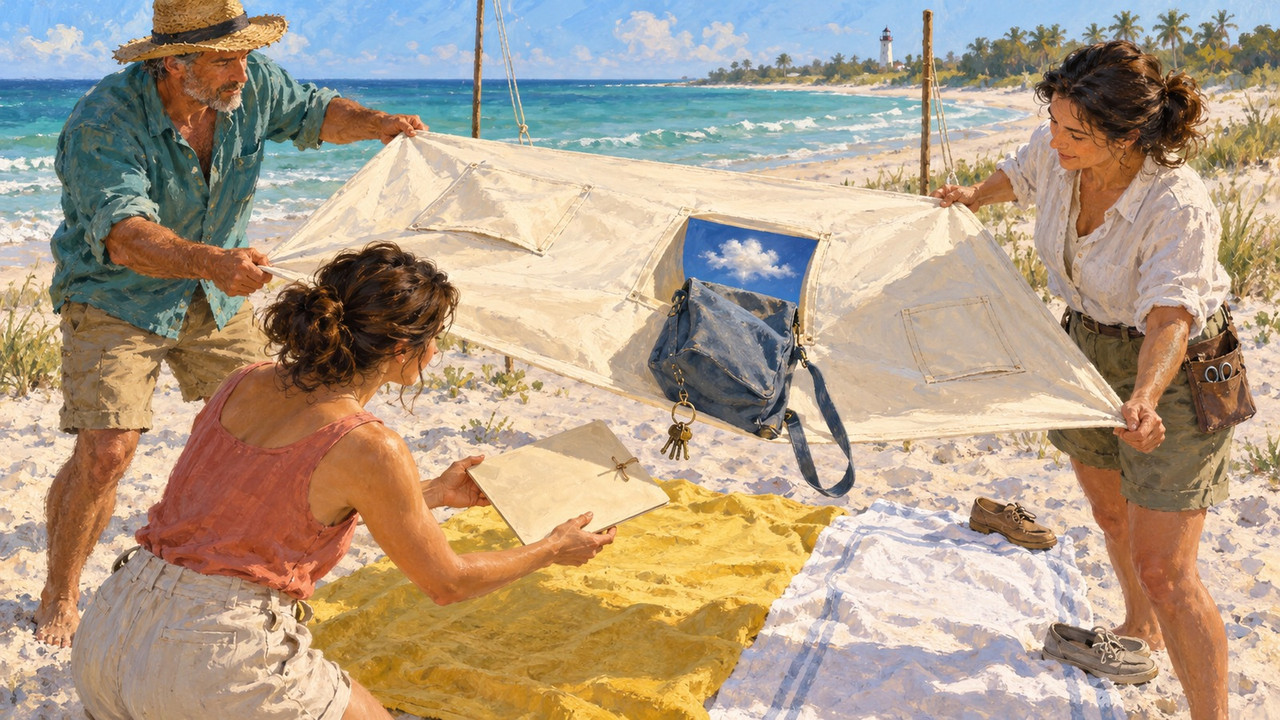
A Gulf fable · Boca Grande
The first thing to fall out of Jo’s new awning was a button. It fell upward.
Florida Man watched it leave her knee, climb past her shoulder, and disappear into a blue pocket beneath the cream sailcloth. Jo kept her needle between her fingers. Neither she nor the needle moved.
“That’s my spare,” she said.
Rosa looked up from opening the lunch bag. “Spare for what?”
“For whatever loses one.”
The pocket held a square of sky. It had depth, bright air and one very distant white cloud. Its horizon was at the top, with the cloud beneath it. Florida Man could see the button dropping through it, although dropping was taking it farther above his head.
He put the lunch bag outside the shade.
They had come to Boca Grande for an afternoon off. Jo had been hemming other people’s clothes all week. Her daughter Rosa was home for two days, and Florida Man had claimed one lunch before the visit filled with errands. There were sandwiches, three bottles of cold water, and a wide beach where no clock needed watching until late afternoon.
Jo had brought a homemade awning. Two short poles and low cords supported it over their patch of dry sand. She had sewn pockets underneath to hold small things people otherwise buried beneath towels. Before the button’s departure, Florida Man had considered this a sound improvement.
Now every pocket contained sky. The largest showed a faint horizon, tilted almost upright. A smaller one had a cloud spread across its mouth, cool and damp enough to leave a dark patch on the seam.
Florida Man held a towel beneath that cloud. A few drops fell into it, obediently downward. He was relieved to see something maintaining standards.
“Only in the blue,” Rosa said. “The rain came out first.”
Jo took a step aside and examined the button through the pocket’s opening. It was still falling. It passed the tiny cloud and became a white point in the distance.
“That can keep the spare,” she said. “We won’t put anything else in.”
She reached for her bag, which hung from the little loop she had sewn between two pockets. Rosa had lent her the bag for the walk: soft blue canvas, with a long strap and a flat envelope inside. The envelope contained Rosa’s drawings for a kitchen table she was making at home. She wanted Jo’s opinion on cushions, rather than four finished cushions by breakfast.
Florida Man wanted to see the drawings. Rosa had described this table for months. It folded against the wall of her small apartment, leaving room to pass with a laundry basket. He had supplied hinges and advice. She had accepted the hinges.
Jo unhooked the strap. Its loose end flicked into the square of blue.
The bag lifted from her hand.
Rosa reached after it. Florida Man caught her wrist before her fingers crossed the pocket’s edge. Above them, the blue canvas turned over and drifted away, its strap hanging toward a sky that lay on the wrong side of the cloth.
Jo lowered her empty hand.
“Your drawings.”
“And my door key,” Rosa said.
She looked up again. “I did bring the spare button’s address, didn’t I?”
Florida Man let go of her wrist. The bag was visible, which gave him something useful to think about. Through the blue square he could see its pale stitching and the brass key ring caught at the open zip. It wasn’t lost in the whole sky above Boca Grande. No blue bag passed between the ordinary clouds. It belonged to this separate piece, trapped below the sailcloth.
He stood beside the pole and looked along the awning’s edge. The upside-down sky bulged beneath it like a second roof. The pockets were openings into that roof, rather than several different skies. He could see the same bag through the next opening, farther off and at a different angle.
Jo fetched her long wooden ruler from the sewing pouch at her waist.
“Can we hook the strap?”
Florida Man held the ruler by its far end and brought the other end into the blue. Its weight changed at once. The wood pulled upward, dragging against his palm. He withdrew it. The bag continued to recede.
He laid the ruler on the sand. Reaching farther would only give the pocket more ruler.
Rosa knelt outside the shade. She watched the dangling zip move toward the horizon.
“It’s falling,” she said. “The key’s hanging down. Just not our down.”
Jo held her needle level, carefully away from the blue. Florida Man could see her thinking through the cloth, as she did through a coat nobody had assembled sensibly.
“I could close the pockets.”
“It would shut the bag in,” Rosa said.
She took the nearest ordinary corner and eased it toward Jo, making a small fold. The blue roof pinched inward. Inside it, the bag moved sharply away from the opening. Rosa flattened the corner again. The bag slowed, but it had lost more of its size.
Folding the awning would make a tidy parcel with a great distance inside. Florida Man had enough troublesome parcels at home.
He loosened the cord at his end and lowered the edge a few inches. The pocket descended. The little sky turned with it, and the bag’s strap swung toward a different seam.
Rosa moved with the corner, watching.
“Hold it there.”
He did. She pointed to the brass ring. The key had swung closer to the opening. Tilting the pocket had brought its tilted world nearer to being upright; the bag had begun to fall back toward them.
Jo looked from the ring to the awning’s two cream sides.
“We’ve put its sky underneath.”
Florida Man glanced up at the great ordinary sky, which remained exactly where a person expected it.
“Can we put it on top?”
Jo felt the hem. The blue stayed below the sailcloth. It did not leak around the edge. If they rolled the whole awning over, the sky would turn with its roof. Right way up, it ought to let things fall out instead of in.
They would have one chance to catch it before the key, drawings and borrowed bag took their separate journeys into the sand.
Rosa fetched the yellow towel from beside their lunch. She spread it beneath the large pocket, then weighed its corners with their shoes. Florida Man put the damp white towel beside it for the smaller opening. Jo set her ruler on the far edge and took out the needle before she forgot where it was.
The bag had become smaller than Florida Man’s thumb.
“Tell me when you can see its zip,” he said to Rosa.
“I can still see it.”
Jo freed the second cord. The sailcloth dipped. Florida Man held his edge out while she gathered hers, keeping the blue spread wide instead of squeezing it into a fold.
They turned the cloth together.
Halfway over, the horizon stood straight up. The bag crossed it sideways, strap first. Florida Man’s arms wanted to bring the corners together. That would have been easier. He held them apart.
“Keep that opening broad,” Jo said.
Rosa stepped away from beneath it. “It’s coming.”
The little sky rolled past the vertical. Its blue deepened. The bag stopped receding and grew, slowly at first, then quickly enough that Florida Man could read the stitched name on its side.
Jo turned her wrists. He followed the cloth across, until the pocket mouths faced the ordinary sky.
Something tugged at the sailcloth. The bag was falling toward an opening now, but its long strap had caught across the narrow mouth.
Rosa reached for the ruler.
“From this side,” she said.
She slid the wood along the outside of the seam, lifting the strap without putting the ruler into the blue. Jo widened the pocket with her fingertips. Florida Man kept the cloth open above the towels, his elbows beginning to tremble.
The strap slipped free.
The bag dropped onto the sailcloth and slid over its low edge. It struck the yellow towel and rolled onto its side. The key ring landed beside it. Rosa caught the envelope before a breeze could open its flap.
Then came the button. It bounced once off Florida Man’s hat and disappeared into the damp white towel.
The blue roof thinned. Above the upturned pockets, small clouds stretched into wisps and joined the bright air. The last square of sky vanished, leaving cream fabric and a row of perfectly ordinary seams.
Jo lowered her edge onto the sand. Florida Man lowered his. For a while all three sat beside the awning, considering lunch from ground level.
Rosa checked the envelope. Her table drawings were dry. The bag contained a little cool air and a loose receipt, both apparently hers.
Jo found the button in the towel. She returned it to her pouch, closed the flap and gave the pouch a firm pat.
They ate the sandwiches without rebuilding the shade. Later, beneath an ordinary patch of tree shadow, Rosa spread her drawings over Jo’s bag. Florida Man recognized his hinges.
Jo put one finger beside the folded table.
“Where do the cushions go when it’s up?”
Rosa showed her the narrow shelf she had built behind it.
Jo studied the drawing, then nodded. “Good. No pockets.”
Florida Man tipped his hat over his knee. A grain of sand fell out and landed exactly where he thought it would.
The real Gulf behind the tale: Gasparilla Island and Port Boca Grande Lighthouse
The light at the southern end of Gasparilla Island once guided ships into Charlotte Harbor. It dates to 1890, according to the official history of Port Boca Grande Lighthouse and Museum. The museum brings together other parts of island life, including local fishing traditions and the phosphate industry. That working history gives the coast a story beyond its beach.
Boca Grande's setting is also shaped by the water around it. Florida State Parks places Gasparilla among the Gulf Coast's barrier islands, with Charlotte Harbor and Pine Island Sound between it and the mainland. The state park occupies the island's southern end. The park and museum accounts are useful companions for readers exploring that geography and maritime past; their current pages also carry visiting information.