Caladesi Island: Florida Man and the Long Way Backward
A Gulf fable · Caladesi Island
Florida Man had brought three sandwiches, two boats, and a firm intention to stay out of the paperwork. The paperwork occupied a yellow envelope in Lena’s dry bag. It was considerably heavier than paper ought to be.
Lena and her younger sister, Tess, had repaired furniture together in Dunedin for eleven years. Now Tess had accepted a boatbuilding apprenticeship, and Lena was buying her share of the workshop. They had settled the price, the payments, and which sister would keep the magnificent old drill that required a slap before it worked.
They had not managed the signatures.
For three weeks, Lena had found something else to check. Tess had stopped dropping by. Yesterday, Lena had asked for one last paddle together before the move, on water all three knew. Tess had agreed, provided the envelope came along.
Florida Man had supplied the trailer. A man could help with a canoe without becoming a lawyer.
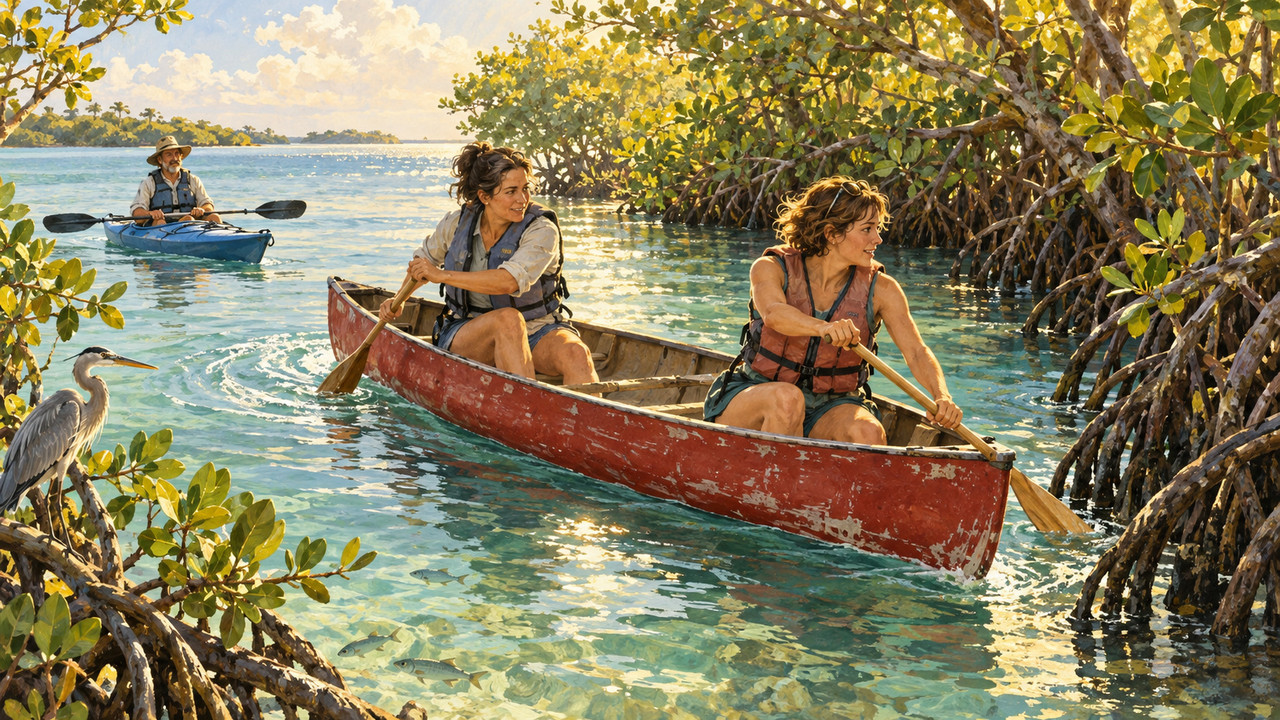
Across the sheltered water beside Caladesi Island, Tess took the canoe’s front seat and Lena the back, as they always had. Their faded life jackets matched by accident. Florida Man slipped into his short blue kayak and followed, giving the sisters enough room to speak without obliging them to.
The morning smelled of salt and sun-warmed rope. A loose strap tapped his kayak with the persistence of a person asking for a favor. Ahead, the canoe moved neatly between low green banks, its red hull carrying a white scrape from some entirely forgotten occasion.
“Your drill’s in my truck,” Tess said.
“Our drill,” Lena said.
“Not after today.”
Lena’s paddle entered the water without a splash. Florida Man suddenly found the loose strap worthy of his full attention.
They rounded a bend into a creek they had paddled on other mornings. Tess pointed with her chin toward a pale limb stretching across the water ahead. Its leafy end rested among the branches on the opposite side. There was water beneath it, but no room for a canoe and the people inside one.
They stopped well short.
“That wasn’t here last time,” Lena said.
“Neither was your envelope,” Tess answered.
Florida Man drifted alongside the canoe. The banks pinched close, and the bend behind them made a crooked corridor. His kayak could turn in the little pocket they occupied. Their long canoe could not.
They could simply back out. He had watched both sisters do harder things on quieter days. At the workshop they could tilt a heavy table through a doorway with half an inch to spare. But there were no table legs here to grip, and Lena was already looking over her shoulder while Tess looked forward.
“I’ll back us,” Lena said. “Tess, keep the front straight.”
They started. For two strokes the canoe slid backward obediently. Then its rear end edged toward the inside bank. Lena corrected, Tess corrected the correction, and the bow swung toward a low branch.
“Hold,” Florida Man said.
Both paddles went still. Tess caught the canoe’s small drift with her blade in the water. No wood touched the bank.
“Too much from the front,” Lena said.
“I was keeping it straight.”
“I meant straight with us.”
Tess looked down at the pale water sliding past her paddle.
Florida Man checked the buckle on his dry bag. It had not needed checking.
“We’ve got plenty of room behind,” he said. “I can go back to the bend and see how it looks.”
He turned his kayak, moved clear, and stopped beyond the curve. From there, the problem was plain: their canoe needed to come back on a slant, rear end first, before the front could follow. A dark fork of root marked the tightest part. Farther out, the creek widened enough to turn.
He called the shape of it back to them, then tucked his kayak into open water beyond the bend.
The sisters tried again. Lena could see behind her only by twisting at the waist. Each time she turned to check, her stroke shortened. Tess kept trying to repair the small swing she could see at the front. The canoe backed a few feet and stopped, crooked again.
Nobody was in trouble. That almost made it worse. They had spent years making awkward things work together. Florida Man could hear how much depended on this awkward thing working immediately.
“Let me call it,” Tess said.
“From up there?”
“From up here I can see both banks.”
Lena turned back toward her sister. “I’ve always steered.”
“Yes.”
The little word sat between them.
Florida Man laid his paddle across his lap. He could have offered to tow them from the wider water. He could also picture two capable women arriving behind his kayak like a couple of disgruntled parcels. He waited.
Tess turned far enough to face Lena without shifting her weight off the seat.
“You said I could run the workshop if you got sick.”
“You could.”
“You said I could buy it if you ever wanted out.”
“You could.”
“But I can’t want something else?”
Lena rubbed a thumb along the wet paddle shaft.
“That isn’t what I said.”
“It’s what you keep checking.”
For a while, the strap on Florida Man’s kayak was the only thing with a reply.
Then Lena said, “I don’t know how to open the place on Monday with just me in it.”
Tess’s shoulders dropped a little. “You should have told me that.”
“I thought you’d stay.”
“I know.”
Florida Man looked away down the creek. Sunlight reached through a gap in the leaves and laid a bright patch across his knees. He eased the tapping strap beneath its buckle.
At last Lena lifted her paddle.
“All right,” she said. “Call it.”
Tess studied the banks. “Short strokes. Together. We’re going to let the back come across before we straighten.”
Lena glanced behind her.
“Look at me,” Tess said. “He’s watching that end.”
Florida Man sat up. “Clear here.”
The canoe began to move backward. Tess counted softly, not a march but the pace they once used to lift a dresser. Lena matched her. The red stern slid toward the outside of the bend, opening room for the bow to swing.
From where Florida Man waited, it looked wrong until it looked right.
Lena’s paddle paused halfway to the water. Another short stroke would put the stern farther from the middle of the creek, the place she wanted it to be. Her body started to turn.
“One more,” Tess said.
Lena faced her sister and planted the blade.
The canoe slid back at an angle, stern passing the dark root fork. Tess pressed her paddle against the water, guiding the bow into the space the stern had left. Lena changed her stroke with her. The hull swung smoothly around the bend.
They emerged stern first into the wider creek, the bow still pointing back toward the obstructed stretch.
Tess set her paddle across her thighs. Lena laughed once, sharply, as if somebody had opened a stubborn jar.
“Well,” Florida Man said. “Very stylish exit.”
“Don’t tell anybody,” Lena said.
“About the style?”
“About how long it took.”
They turned in the open water and chose another short stretch for their morning. Tess called out a snag. Lena answered that she saw it. Their strokes settled into an ordinary rhythm, and Florida Man let them pull ahead.
When they reached a picnic table later, he handed out the sandwiches. Lena put the yellow envelope beside hers. Tess sat across from her, holding a napkin flat against the breeze.
Lena read the agreement through. This time she found no missing comma and proposed no additional conversation with somebody’s cousin.
“I’ll need another pair of hands some days,” she said.
“You can hire them,” Tess said. “That’s in the figures we did.”
“I know.”
She uncapped her pen.
“And I’d like you to call me when you get there.”
Tess smiled. “That’s not in the figures.”
“No.”
Lena signed. Tess signed beneath her. They separated the copies, and Lena slid one across the table.
Florida Man kept eating until both women had put their pages away. Then he asked who wanted the pickle.
They both did.
After an inspection more serious than the paperwork had received, Tess cut it lengthwise with the edge of her sandwich knife. Lena took the slightly larger half and pointed it toward Tess’s truck.
“Help me carry it in when we get back?”
“Of course,” Tess said.
Florida Man folded the empty sandwich bag. He still had two boats to put on the trailer, and now, apparently, a drill to carry. These were the sort of arrangements he understood.
The real Gulf behind the tale: Caladesi Island's mangrove waterways
Mangrove roots make part of Caladesi's shoreline a place where young fish and crustaceans can shelter from larger predators. They are one feature of a varied island, rather than its only landscape. Caladesi Island State Park, off Dunedin, describes the mangrove forest on the bayside.
The park's habitat account also identifies maritime hammock with live oaks and cabbage palms, and pine flatwoods where saw palmetto grows beneath slash pines. Plants do other work nearer the water: beach elders and sea oats help secure dune sand with their roots. Offshore, seagrass beds supply food and cover for aquatic animals; manatee grass, turtle grass and shoal grass occur there. Looking at shelter, food and sand-holding roots reveals several different ways that Caladesi's vegetation shapes places for life.