Cedar Key: Florida Man and the Map of the Missing Station
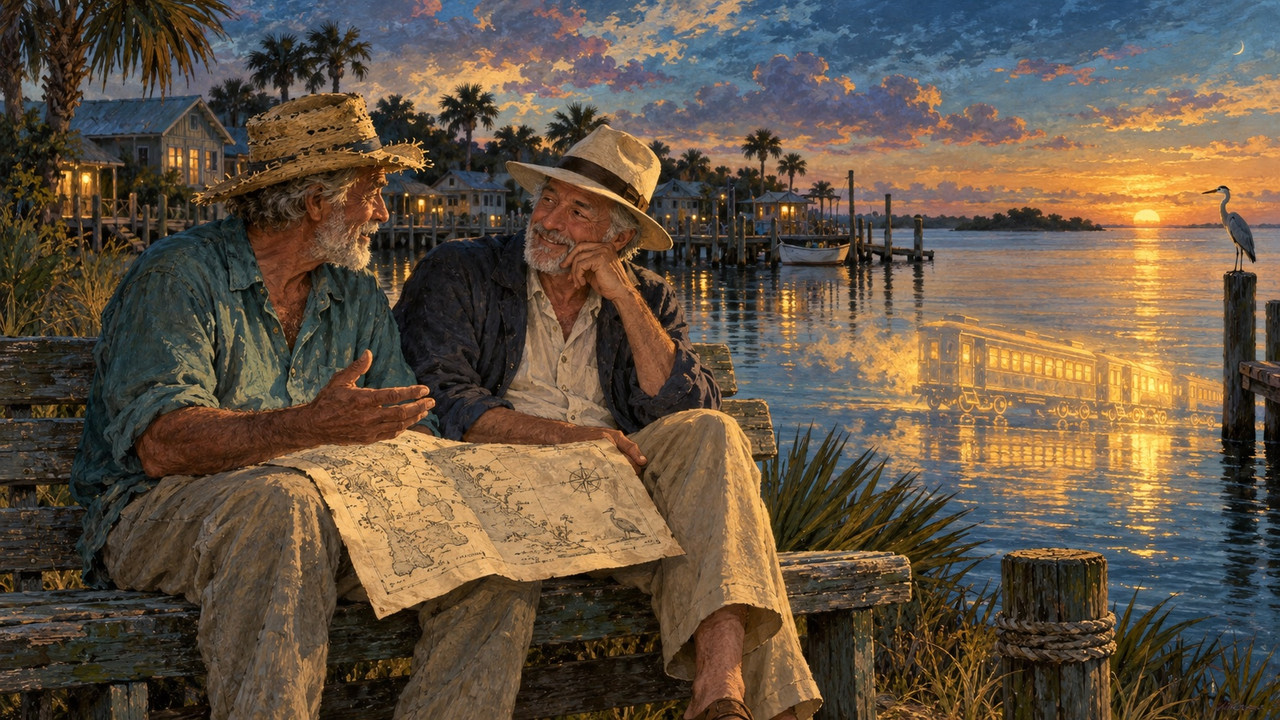
A Gulf fable · Cedar Key
The old railroad map of Cedar Key had a small problem with Florida Man. Every time he chose a direction, it folded away the part he needed.
He flattened it against his knee. The line returned, thin and brown, running toward a station he had never seen. Beyond it lay the afternoon he had promised his oldest friend.
“Still know your way around?” Walt asked.
“Of course.”
The map developed another crease.
Walt had arrived that morning wearing a hat Florida Man didn't recognize. Once, Florida Man would have known where he'd bought it, why he'd bought it, and which unfortunate hat had preceded it. Now he knew that Walt lived across the state and preferred driving before the traffic got lively. Most of the years between those facts had slipped past in Christmas messages.
Florida Man had missed Walt's last two visits. Work had run late on one. On the other, he'd promised to stop by after finishing something at home and had never quite finished it. Walt had said he understood. Eventually he had stopped mentioning visits.
Today, Florida Man had kept the afternoon clear. He intended to make it worth the trip.
He had found the map tucked into a secondhand book that morning. The paper smelled of a drawer opened after a long summer. Cedar Key's railroad history had always interested him, and the drawing showed a handsome little railway carriage beside the water. There was a platform, a clock, and a bench with room for two.
The curious part was the clock. Its hands moved when he wasn't looking.
He had decided to show Walt the map after lunch. Now its station seemed a better destination than anything he had planned. Walt liked a mystery, especially one that could be investigated in comfortable shoes.
Florida Man led him along a route they had known as boys. They passed a yard fragrant with warm grass, then a corner where Florida Man remembered buying ice cream with coins softened in his palm.
“Used to be a little shop,” he said.
Walt nodded. “You always bought the same thing.”
“A sound policy. I had limited funds.”
The map showed the shop in a wash of pale yellow. As Florida Man pointed toward where the door had been, the picture faded. The drawn track stopped halfway across the page.
He turned the map. The clock lost a minute.
He took them farther along, describing another remembered place. That faded, too. The map wasn't deleting the town. It was leaving little empty spaces in the afternoon he'd arranged.
Walt walked beside him without complaining. Florida Man was beginning to recognize that particular courtesy.
“We could get something cold,” Walt said.
“The station's close.”
“Is it?”
Florida Man examined the line. It had turned back toward the corner they had just left. He could have accepted a drink, a seat, and the ordinary afternoon available to them. Instead he decided that a mystery required persistence.
They returned to the corner. There was no platform. A cat occupied the warmest patch of shade and declined to assist.
Florida Man took out a pencil. If the old map didn't know the present town, he could bring it up to date. He drew the route they'd walked and marked the corner. Then he added a straight line toward the water, where the station ought to be.
His line lifted off the paper.
It curled into a small brown loop above his hand, dropped onto the page, and became a picture of Florida Man holding a map. Walt was drawn beside him, looking toward a bench outside the picture.
“That's unnecessarily personal,” Florida Man said.
Walt leaned over his shoulder. “It got your hat right.”
The railway clock advanced. Somewhere beyond the houses came a low, clear whistle. Florida Man felt it in his ribs before he heard it properly.
Walt smiled, the quick, crooked smile Florida Man remembered.
“All right,” he said. “One more corner.”
They followed the sound toward the waterfront. The air opened around them. At the edge of the map, the drawn water trembled into tiny moving waves. A platform appeared along a strip of shore that Florida Man could have sworn had been ordinary a moment earlier.
The little carriage waited there, lit from within. Its windows held scenes instead of passengers: a boy with melted ice cream on his wrist, two bicycles leaning together, a pair of bare feet swinging beneath a much younger face.
Florida Man stopped. He knew those feet. He had once thought Walt would be beside him for everything worth doing.
The map's line reached the platform but left a gap no wider than his thumbnail. The carriage door opened. A breeze stirred the paper against his fingers.
“Well,” Walt said softly.
Florida Man looked at the carriage, then at his friend. He had finally found something remarkable enough to make up for the afternoons he hadn't given him.
He started toward the door.
Walt stayed where he was. His hand rested on the back of an ordinary waterfront bench.
“Knee's giving me a little trouble,” he said. “I'll sit while you have a look.”
Florida Man had not known about the knee. He hadn't noticed Walt walking more slowly, either. He had kept matching their pace to a map that refused to behave.
“Since when?” he asked.
“A while. It's manageable.” Walt lowered himself onto the bench. “The hat's new, though.”
He said it lightly, offering Florida Man somewhere comfortable to begin.
The carriage stood open. In its nearest window, the boys were running toward a summer that had never asked either of them to make an appointment. Florida Man could almost smell the hot bicycle tires.
The whistle sounded again.
He folded the map once, carefully, and put it on the bench.
“Tell me about the hat,” he said.
Then he sat down.
The carriage began to move. Florida Man kept his eyes on Walt. He felt the rare afternoon sliding past behind him and had a brief, sharp wish to turn around. He let it pass.
Walt told him about a trip with his granddaughter. There had been a hat display, a determined child, and a photograph that made Walt's old hat look like a collapsed flowerpot. The granddaughter had settled the matter.
Florida Man laughed. He asked her name. He asked what she liked besides improving hats. Walt told him.
By the time they had worked through her interests, the carriage had become a bright reflection beyond the bench. Walt asked about Florida Man's work, then about the thing at home that had kept him away last time.
“It wasn't worth missing you,” Florida Man said.
“Most things aren't as urgent the next morning.” Walt turned his hat in his hands. “I wasn't sure you still wanted the company. Didn't want a visit to be one more thing to fit in.”
“Would you put up with a visit from me?”
Walt grinned. “Within reason.”
Florida Man opened the map between them. The line had changed. It ran through the ice-cream corner, around the unhelpful cat, and down to the bench. Here it crossed the small space between two penciled figures and continued into a part of the page that had been blank.
Walt held one edge while Florida Man smoothed the other. The gap closed beneath their hands.
They went for something cold after that. Florida Man let Walt choose the pace. Before his friend left, he asked when he could come to Walt's place.
“You'd drive all that way for an afternoon?” Walt asked.
Florida Man looked at the unfamiliar hat. “You did.”
They chose a Tuesday. He opened his calendar and cleared the afternoon, then wrote the date and Walt's address on the back of the map. They could meet the granddaughter if she was around. They could sit in the yard if she wasn't. Neither plan required a railway station.
He kept the map in his truck. It was no use for directions. It regularly put the cat in the wrong yard.
But whenever he said he would stop by after finishing something, the paper developed a crease he could feel through his pocket.
The real Gulf behind the tale: Cedar Key railroad history
Cedar Key's waterfront once connected a Gulf port with the Atlantic side of Florida. The state's Atlantic to Gulf Railroad historical marker identifies the line from Fernandina to Cedar Key as Florida's first cross-state railroad. That connection belongs to the town's history, alongside industries that sent local materials much farther afield.
Florida State Parks' account of the Cedar Key cedar industry describes wood shipped north for Eberhard Faber's pencil factories. A familiar pencil therefore has a place in the story of this small coastal town. The park's museum history also records the St. Clair Whitman Museum's opening in 1962 and its later name, Cedar Key Museum State Park. Together, these sources offer a useful beginning for exploring Cedar Key history through its railroad, waterfront, working materials and preserved collections.