The Door Beneath Carrabelle
A Gulf fable · Carrabelle
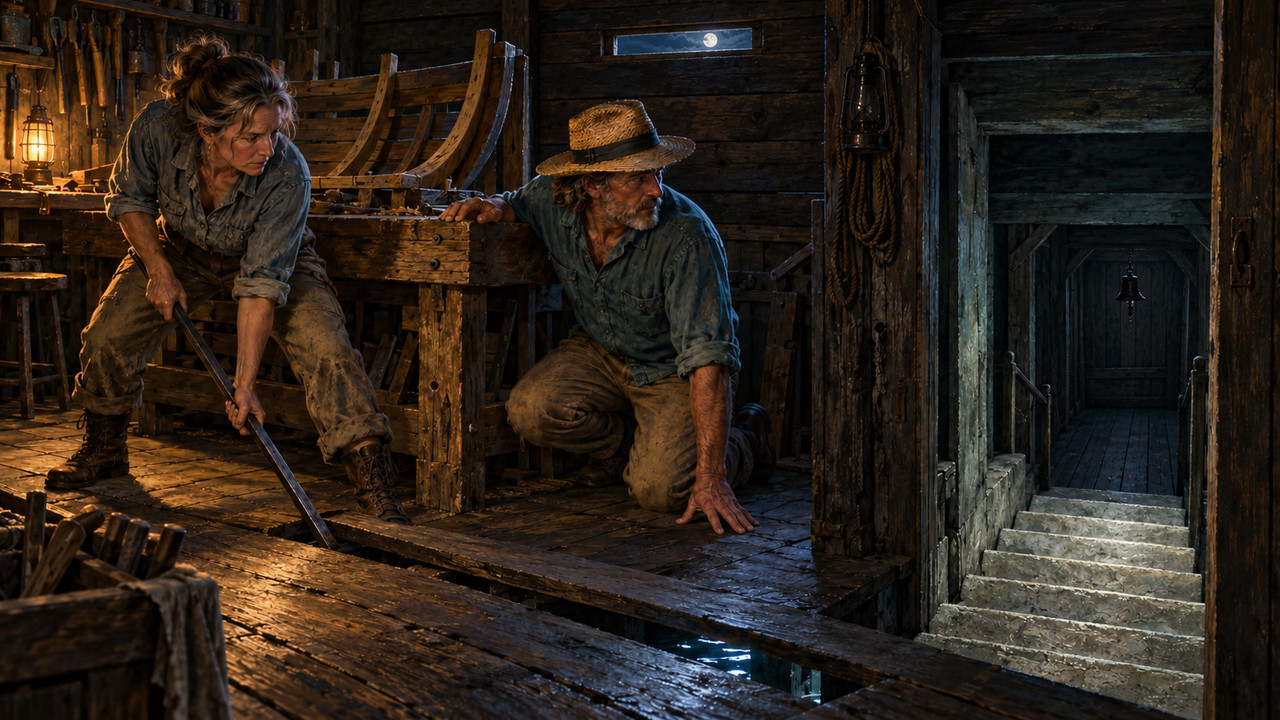
The bell rang beneath Mara’s workbench while Florida Man was holding the heavy end.
He felt its note through the wood. It traveled up his wrists and settled behind his teeth, a low, round sound that belonged to something much larger than the little boathouse.
Mara lowered her end onto a block. Outside, the Carrabelle harbor lay dark between its scattered lights. Water clicked against the pilings. Somewhere a loose rope struck a mast with a sound Florida Man could account for.
“You’ve got a bell under here?” he asked.
“I’ve got three buckets and a socket wrench I haven’t seen since June.”
They waited. The bell kept quiet.
Mara repaired wooden boats in the shed, working alone most days. Florida Man had come to help shift her bench away from a troublesome floor seam. Tomorrow she needed room to lay out a long hull panel. He had promised her an hour and brought his shoulder, a pry bar, and sandwiches wrapped in paper that now smelled agreeably of mustard.
Mara had enough unfinished things asking for her attention without his becoming another one.
They lifted together. Beneath the bench stood a door.
It was a narrow, upright door set into the wall where a shallow shelf had been. Florida Man remembered the shelf. He had put his sandwiches on it. Now they rested on a stone sill, beside a black iron latch.
Mara touched the surrounding boards. “That wall’s one board thick.”
Florida Man looked through a gap above the door. Beyond it lay harbor water. The moon made a trembling silver stripe across the surface, just below their floor.
He raised the latch.
Dry stone steps descended into a room beneath the water.
The first step held pale sand that retained the print of his shoe when he tested it. Below, his flashlight showed walls of close-fitted timber and an iron bell hanging from a crossbeam. A white rope passed through the bell’s crown and disappeared into darkness overhead. Nothing dripped. The air smelled like the inside of a cupboard shut for years.
“Don’t go down,” Mara said.
He stepped back at once. She caught the door before it could swing closed and wedged the pry bar beneath it.
“We can look from here.”
Florida Man turned toward the loading doors, intending to fetch the longer light from his truck. In their place stretched a plain wooden wall.
The doors had been wide enough for a boat. He had come through them carrying his sandwiches less than an hour earlier.
Mara crossed the shed. She pressed both hands to the boards, then found the small pencil mark where she measured hulls. The mark remained. The doors, hinges, and the damp evening beyond them had vanished.
She went to the narrow landward door. Its latch lifted, but the door would not move.
Florida Man joined her. He put his weight against it, carefully at first, then hard enough to make his shoulder ache. The frame held. There was no wind pushing back, no familiar give in the old hinges. It felt like leaning against a tree.
Behind them, the bell rang again.
Their landward door disappeared beneath Florida Man’s hand. His palm slid down bare timber.
He could hear his own breathing. Mara’s was slower. She had gone very still, which he found worse than if she had shouted.
“The window,” he said.
It was still there, a small square above the bench. Moonlight lay on its sill. Mara climbed onto the block and pushed at the sash. It rose an inch, then stopped. Florida Man held the block while she tried again.
The light narrowed.
Wood crept into the opening from both sides, quietly, carrying the grain of the wall with it. Mara pulled her fingers away before the sash pinched them.
Florida Man swept his flashlight back down the stone stair.
The room now had two doors. One was painted green and carried Mara’s familiar brass latch. The other was broad and double, with the chalk smudge Florida Man had left on it that evening. Both stood in walls that should have been underwater.
“It’s taking them,” he said.
Mara recognized the chalk and the green paint. She reached for the pry bar wedging the threshold, then stopped.
“We need that one open.”
Below, the white rope drew taut. The bell lifted slightly, as though someone above the roof had begun to pull.
Florida Man had no wish to meet whoever was at the other end.
His phone had no signal. He tried a call anyway and got silence. Mara shouted through the shrinking window. Her voice struck the closed walls and came back flat. The harbor sounds had stopped.
He knelt beside the troublesome floor seam. A bead of water shone in it. The tide pressed up between the boards in small, cold breaths.
He dipped a rag into the seam and carried it to the stone stair. A drop fell onto the sand.
The drop spread. Where it touched, the pale stair darkened to rotten wood. Beneath that brief, ragged patch he saw moving harbor water.
Then the sand drew together and covered it.
Florida Man held the rag over the next step. Mara watched another dark patch open and heal.
“The water’s still under us,” he said. “Whatever this is, it keeps shutting it out.”
Mara looked from the rag to the floor. “So we let it in.”
She fetched her saw from its hook. Florida Man pictured the thick joists, the weight of the bench, the hull panel due tomorrow. Mara had replaced this floor herself. Each sound board had cost her hours she could have charged to somebody else.
“Where can we cut?” he asked.
She pointed along a plank beside the impossible threshold. “That one ends between the joists. Cut the tongue. I’ll lift it.”
They worked with their backs to the narrowing window. The saw’s harsh little cry filled the shed. Florida Man knelt on a dry board and kept his cuts shallow. Mara drove a second bar beneath the loosened edge. Each time she lifted, the bench rocked.
Downstairs, the bell began to swing.
It had not struck yet. Florida Man could see the clapper traveling from side to side, missing the rim by less each time.
The plank came up an inch. Water welled beneath it, black and real. The stone threshold shuddered.
“More,” Mara said.
He moved the block under her bar. She leaned with both hands. The plank split lengthwise and a cold jet struck her wrist. Below, the green door snapped open onto darkness. The landward latch appeared in the shed wall, half buried in returning wood.
Florida Man lunged toward it. He dragged the door inward until its bottom caught. Through the gap he smelled mud and heard a boat engine far across the harbor.
“It’s coming back!”
Mara’s bar slipped. The broken plank settled, choking the water to a trickle. The door began to draw shut against Florida Man’s shoulder.
He thrust the block into the gap. It cracked.
Mara looked at the workbench. Its front legs stood on the boards they needed to remove. Bolted to the top was the curved jig she had spent most of the summer fitting for the next job.
“Help me turn it,” she said.
“It’ll go through.”
“I know.”
They got beneath the near edge. Florida Man’s sore shoulder burned. Mara counted, and they heaved. The bench tipped. Its far legs punched through the loosened floor, dragging the jig down with it.
Harbor water surged into the gap. The dry stair broke apart in strips of sand and black timber. The bell swung once toward Florida Man, so close he saw salt crust around its lip.
Mara seized his sleeve.
The landward door sprang open. They ran through together as the bench fell, carrying the pale room out of sight. A tremendous wooden crack followed them onto the shore. Water slapped the broken floor from below.
No bell sounded.
Florida Man sat in the mud beside Mara until he could trust his knees. She held the bent saw in her lap. Neither spoke while the harbor gradually returned around them: an engine, a rope, a fish breaking the surface.
At dawn they looked in from the doorway. Half the floor was gone. Mara’s bench lay wedged between two pilings. The jig had broken. Her shelf was back, and the sandwiches sat on it in their greasy paper.
Mara picked them up. “Breakfast,” she said, though neither managed much.
They roped off the shed. Mara would have to call the people waiting on her work. Florida Man would return with lumber, but the calls would still be hers.
As she locked the landward door, he noticed pale sand on the outer step.
Two sets of footprints led out of the shed. His shoes. Mara’s boots.
Between them lay one narrow track of bare feet, beginning at the threshold and continuing toward the road.
Florida Man followed it with his eyes until it disappeared on the dry ground.
Nothing had walked beside them in the mud. He was certain of that.
Mara turned the key. From inside the empty shed came the faint sound of a latch being lifted.
Carrabelle’s Crooked River Lighthouse and working waters
Carrabelle’s maritime history includes a light built to help people find their way through difficult coastal waters. The Crooked River Lighthouse, also called the Carrabelle Light, first shone on October 28, 1895. Its mainland location served ships using the channel west of Dog Island, including vessels in the lumber trade. The lighthouse’s official history also describes its role in guiding local fishermen and oystermen through the pass between Dog and St. George Islands.
Construction began in January 1895 on a 100-foot iron skeletal tower. The original station included two keepers’ houses, an oil house, a pier, and other outbuildings. These details place the beacon within a working shoreline of supplies, boats, timber, and daily maintenance. They offer a real historical backdrop for Carrabelle’s harbor atmosphere. The Crooked River Lighthouse’s history page follows the tower’s construction and later preservation, with photographs of the station and its keepers.