Tarpon Springs: Florida Man and the Sponge That Held a Town Together
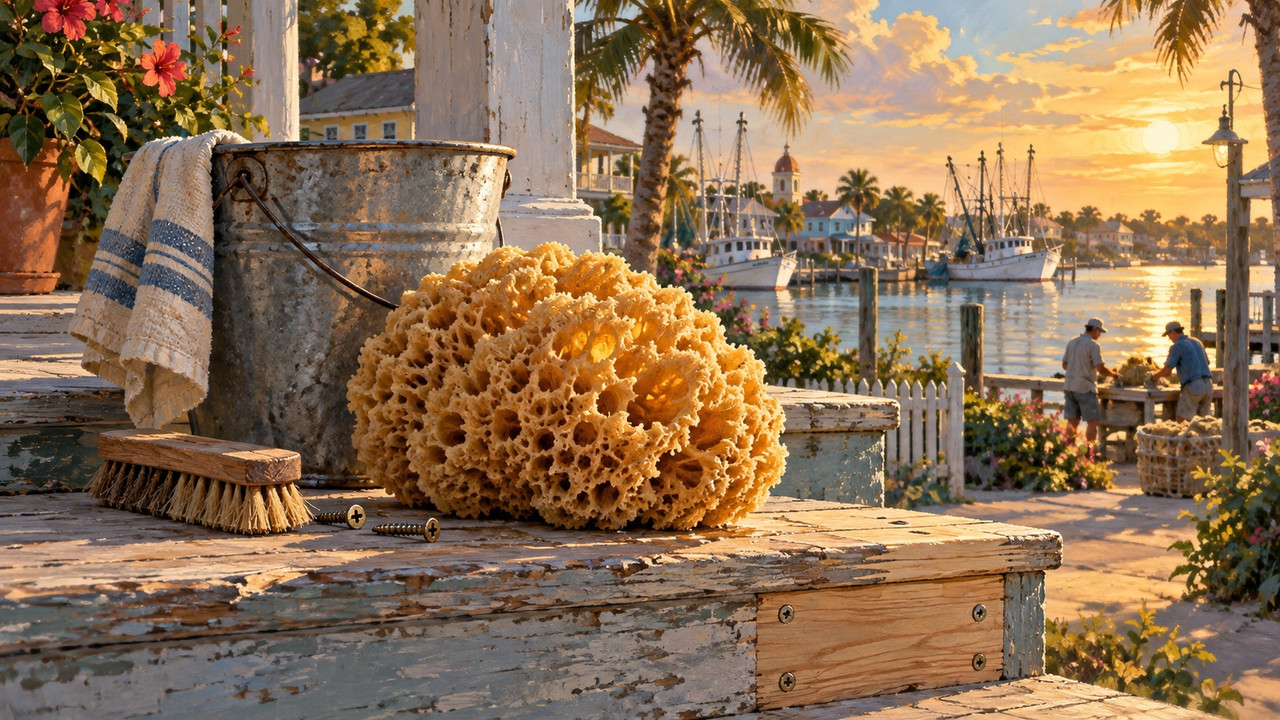
A Gulf fable · Tarpon Springs
Florida Man had bought the finest sponge he could afford at the Tarpon Springs Sponge Docks, and now it was refusing to wash a porch.
“The wood needs attention,” it said.
“The wood needs soap,” Florida Man replied. He had promised his neighbor Rosa a clean porch before her daughter arrived for supper. It was already late morning. He could manage a sponge with opinions, provided those opinions came with a little scrubbing.
The sponge sat in his hand, honey-colored and full of small rooms. Beyond the yard, the warm air carried the smell of somebody baking bread. Rosa had brought out a bucket and gone inside to finish the meal. Her daughter's blue chair waited by the door, freshly wiped, with a cushion that Rosa had been saving for a special occasion.
Florida Man had promised to help with this porch before. Usually he passed the house on his way somewhere and called, “Soon as I've got a morning.” He had possessed several mornings since then. He had spent one cleaning the truck.
Today he meant to finish. Rosa had once stayed beside his father in a waiting room while Florida Man was stuck across town. She had brought two sandwiches, though nobody had asked her to bring anything. The favor had lived in his chest for years, a small debt he wanted to settle properly.
He dipped the sponge into the bucket.
“I have held a town together,” it said. “I can survive a little soap. That board cannot.”
“You're a little small to have held a town together.”
“You're a little sunburned to be judging structural matters.”
He knelt at the edge of the porch and worked carefully. The first stroke lifted a gray stripe of grime. The second exposed a split around a screw. He pressed the board lightly with his thumb and felt it move. The sponge had been right, which was irritating, but less irritating than pretending it hadn't.
Florida Man set the bucket down. He checked the steps without walking onto the loose section. Another fastening had pulled free. Washing would leave Rosa with a cleaner version of the same problem.
From the kitchen came the clink of a spoon against a pot. He could tell her now, while she still had time to move supper inside. He could also replace a board, fix the railing, and give her the surprise he had meant to give her all along.
He chose the surprise.
“Stay,” he told the sponge.
“I've no appointments.”
At a nearby shop he bought screws, then carried a sound piece of spare lumber back from his shed. He brought his saw and a tape measure this time. Some of his ideas deserved suspicion; his measurements did not need to join them.
Rosa came to the door as he laid out his tools.
“Thought you were washing.”
“A board wants replacing. I'll have it ready.”
“Are you sure?”
He looked at the blue chair, then at the kitchen towel over her shoulder.
“Go on with supper.”
She watched him a moment longer. He was grateful when she went inside. He would have been wiser to notice why she had hesitated.
The old board came away readily enough. Underneath, the edge of a support had softened. Florida Man stopped. He knew what he could repair, and he knew when a piece of wood ought to be looked at by somebody who knew more. He had just crossed from one category into the other.
His careful little job now contained an open space and a question he could not answer.
By the time he had cleared his tools and marked off the work area, the sun had moved onto the porch. Rosa appeared carrying the cushion.
“I'll put the chair in the dining room,” she said.
“There's still time.”
“Time for what you thought it was, maybe.” She wasn't cross. That made the words harder to hear. “My daughter's coming here to see me. She won't mind where we sit.”
Florida Man took the chair inside for her. The room was tidy and warm, and the table had already been set. Through the window he could see his bucket beside a porch that was less ready than when he had arrived.
He went back out and sat on the low garden wall.
In the sponge, a bead of water appeared. It held a tiny window full of flour dust. Another showed a boat tied at a dock, with two hands mending something on its deck. In a third, a woman passed a plate across a table. The pictures were so small he had to shade them with his palm.
“What's all that?” he asked.
“Work,” said the sponge. “The bits people forget when they admire the finished thing.”
He watched the hands on the boat. Somebody outside the drop passed them a tool.
Florida Man knew a carpenter named Leon. He had helped Leon unload a heavy cabinet the previous winter and refused the offered lunch because he had been in a hurry. He knew the woman at the hardware counter, too. She had asked what the screws were for, and he had answered, “Just a little job.”
He had kept shrinking the job every time somebody offered to see it.
Inside, Rosa was moving plates.
Florida Man went to the screen door. “I made this more trouble than you asked for,” he said. “I can call Leon to look at the support. If you'd rather have us come back tomorrow, we'll leave it safe and clear now.”
Rosa put down a plate. “Will he be hungry?”
Florida Man laughed, relieved and a little sore at himself. “Usually.”
“Call him. And ask my daughter to pick up bread.”
Leon arrived with his own tools and a quiet way of looking at wood. He examined the exposed section and explained what it needed. Florida Man listened without supplying a better idea. That alone saved a surprising amount of time.
The woman from the hardware shop came by with the right fittings on her way home. Rosa brought water, then stayed to help hold a length of trim for marking. A boy from next door gathered the removed screws into a jar, with the concentration of a bank official receiving a difficult deposit.
Work moved around the porch instead of piling up in Florida Man's hands. He carried what Leon asked him to carry. He held the new piece while Rosa checked where it met the step. The sponge waited on the bucket, making no useful contribution beyond looking pleased.
Then Rosa's daughter arrived.
Florida Man saw her car through the gap in the hedge. The last board was ready, but not yet seated. There were tools to put away. He felt the old urge to announce that everything was practically finished and hurry the final part.
Instead, he set his drill down and went to the gate.
“I owe you a proper porch,” he said. “We're close. Give us a minute to finish it right.”
She looked past him at her mother holding a tape measure.
“Looks like you've got a supervisor.”
Rosa smiled. “He needed one.”
Her daughter set the bread inside and came back out. With Leon directing, Florida Man lowered the board into place. He held it steady while the first fastening went home. Rosa's daughter braced the other end. The board settled flush, without the little curl that had caught Rosa's slipper for months.
He let go only when Leon nodded.
They cleared the tools, checked the finished work, and washed away the sawdust. When Florida Man finally returned the blue chair to the porch, Rosa walked beside him without looking down at her feet.
The meal stretched beyond the dining table. Leon stayed for a plate. The boy took bread home. Rosa and her daughter sat on the porch while the evening loosened the heat from the boards.
Florida Man rinsed the sponge at the outdoor tap. Its little rooms held new drops: the screws in their jar, Rosa's measuring hand, Leon accepting a second helping.
“You said you held a town together,” he murmured. “Looks like the people did that.”
“I was wondering when you'd notice.”
He laid it on the clean step to dry. His truck still had a long gray stripe down one side.
For once, he knew exactly what could wait.
The real Gulf behind the tale: Tarpon Springs Sponge Docks history
The sponge industry shaped much more than the waterfront in Tarpon Springs. A Florida historical marker on the Tarpon Springs sponge industry dates local commercial sponging to about 1890. It credits John Cocoris with introducing sponge diving locally in 1905, adding diving to the earlier practice of retrieving sponges with hooks. The marker also records the Sponge Exchange's incorporation in 1908 to provide storage and sales.
The National Register nomination for the Tarpon Springs Historic District gives a fuller picture of the community behind that work. Greek immigrants established restaurants, bakeries and retail shops, built boats, supplied the fleet, and developed institutions around their shared life. Tarpon Springs sponge diving history is therefore also a history of people making one another's work possible. Those linked trades, rather than a single spectacular exploit, give this Gulf story its setting. The marker and nomination offer useful starting points for understanding the Sponge Docks beyond the sponges in a shop window.