Fort Myers: Florida Man and the Fruit That Bounced Back
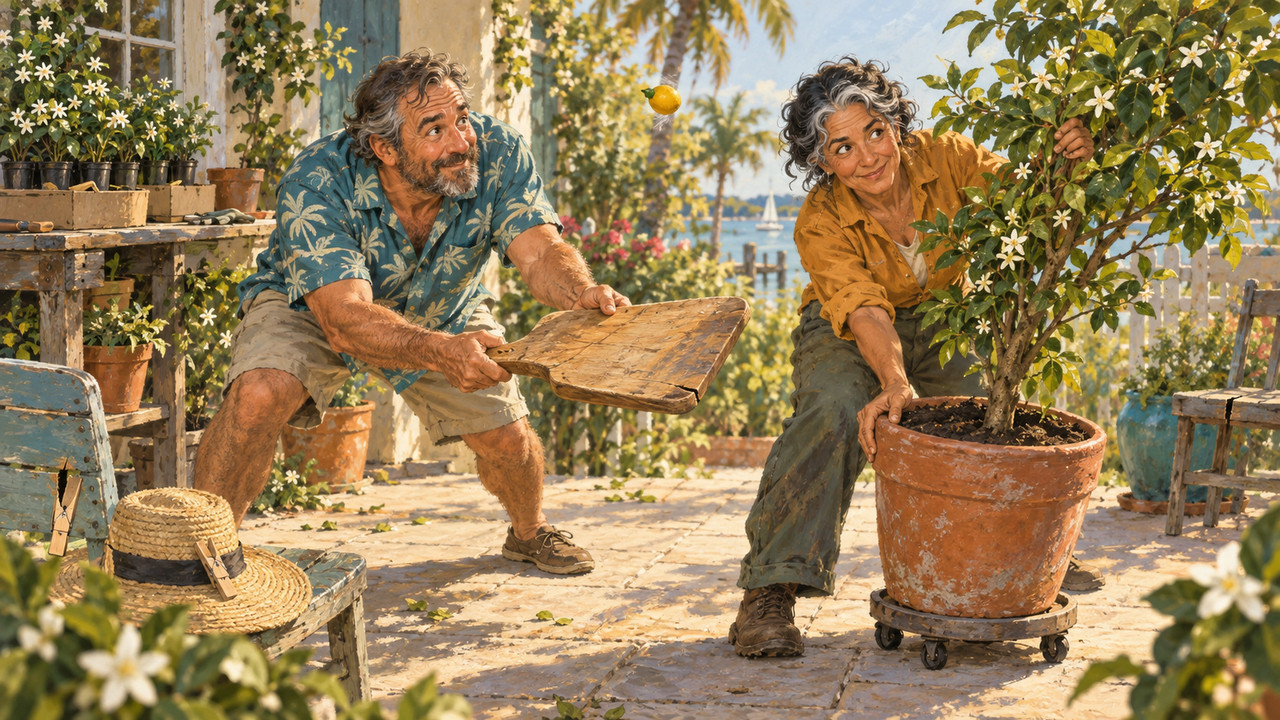
A Gulf fable · Fort Myers
The fruit struck Florida Man's hat, and the hat struck Florida Man.
He had taken it off to catch what Alma called a promising result. Now it lay on the paving stones, its brim trembling like a plucked string.
The fruit, a small yellow thing with a green tip, landed on a wooden chair. The seat dipped beneath it, stretched impossibly, and fired it toward the washing basket.
“Promising what?” Florida Man asked.
Alma did not answer. She was moving the basket.
They had been packing plants in her Fort Myers yard. Three friends were coming to trade cuttings that afternoon, and Alma had spent the morning fitting little pots into cardboard dividers. She had promised Rita a tray of rooted jasmine. Rita had promised her a division of an orchid that Alma had been admiring, with increasingly transparent casualness, for four years.
“I mentioned it twice,” Alma had said.
“This morning?”
“Recently.”
Her yard was narrow, crowded and beautifully considered. A long bench held the packed plants. Beyond it stood a little citrus tree in a broad clay pot on a wheeled base. Alma had grown the tree from a seed somebody had saved for her. It bore exactly one fruit, and neither of them had recognized the variety.
The fruit had dropped quietly into its own pot while they worked. Alma had lifted it out on a wooden spoon to show him. It had struck the spoon, bent the wood like rubber and leaped. Florida Man's hat had been the nearest useful-looking object.
That was before useful-looking objects became unreliable.
Alma pulled the washing basket away from the plants. The fruit landed inside it. The bottom sagged almost to the paving, then sprang up. Two clothespins flew out. So did the fruit.
It hit one paving stone, which dimpled beneath it as gently as a cushion. Then it shot sideways under the bench.
Alma stood still.
“Those are the jasmine.”
Florida Man could see the little yellow thing hopping in the narrow space beneath them. Each landing made one small patch of the world elastic. Behind it, the basket had become an ordinary basket again. His hat lay flat. The chair seat looked perfectly solid.
The fruit bounced against the underside of the bench.
The plank bowed upward. Above it, a tray lifted an inch, landed crookedly and began to slide.
Alma caught the tray with both hands.
“Get the other end.”
He did. Together they lifted it clear as the fruit shot between his shoes. The bench stiffened again. A small pot tipped in its divider, shedding soil down Alma's wrist.
They carried the tray onto the back step. Alma settled the tilted plant with two fingers. Its white roots were showing at the edge of the soil.
Florida Man reached for his hat.
“Leave it,” she said. “It's had enough.”
The fruit was crossing the yard in short, energetic hops. Wherever it landed, the surface gave beneath it. As soon as it struck somewhere else, the previous spot went firm.
Alma watched a paving stone flatten behind it.
“Only one place at a time.”
“That's considerate.”
“It's a start.”
He moved the remaining trays to the step while she stood between the fruit and the bench with a large breadboard. When it came toward her, she tipped the board into its path. The wood bent, and the fruit rebounded toward the empty end of the yard.
She stared at the board in her hands. It had gone straight again.
“I can send it away.”
“Can you send it somewhere particular?”
On its return, she tried. The fruit struck low on the board and flew left instead of right. She had to step aside, laughing despite herself, as it made a quick visit to her apron.
The apron puffed outward. Its pocket launched a pencil over Florida Man's shoulder.
He heard it land in a watering can.
“That particular enough?” Alma asked.
He fetched a shallow wooden drawer from beneath the bench. It held empty plant labels, which he poured into the basket. If they could trap the fruit between the drawer and the breadboard, they could carry it back to the tree and consider its future.
Alma steered it toward him. He laid the drawer on its side, open toward the next hop.
The fruit went in.
For a glorious moment, the yard was still.
Then the drawer's back stretched into a bulge. It snapped forward, hurling the fruit through the opening before Florida Man could cover it. The drawer skidded into his shin.
“You could've said no,” he told it.
Alma put a hand against the tree's pot. The next bounce passed close enough to stir its leaves.
“It was quiet in here.”
He looked at the dark soil. A small hollow showed where the fruit had first fallen.
“Before you picked it up.”
“I thought it was finished growing.”
They watched it spring off a paving stone and strike the foot of the chair. The chair leg flexed. The fruit shot under the bench again.
“We ought to put it back,” Florida Man said.
The clay pot was too broad for Alma's arms, but its base had wheels. She freed one wheel from a crack and rolled the tree toward the middle of the paving. Florida Man took the breadboard and kept the fruit away from her feet.
He began to feel the timing. The board yielded with a soft tug against his palms; then came the push. Held upright, it sent the fruit sideways. Tilted back, it threw it higher.
His first attempt at the pot sailed over the tree.
“Lower,” Alma said.
“I was hoping the tree might help.”
“It's already done quite enough.”
They moved the pot closer to the bench. Alma turned the leafy branches aside, exposing the soil. There was a clear opening, but only if the fruit came down from above. A sideways shot would hit the clay rim and start another argument.
Beyond the open gate, a car slowed. Rita leaned out of its window.
“Shall I bring the orchid round?”
“Stay there a moment,” Alma called.
The fruit struck the chair again. This time the old seat split along a weathered join. One narrow board fell through, and the fruit bounced off it toward the back step.
Toward the jasmine.
Florida Man could reach it with the breadboard, but the angle would send it straight into the pots. Alma saw that too. She caught the handle of the wheeled base and hauled the tree clear of his elbow.
“Let it come to you.”
He crouched. The fruit landed in front of his shoes. The paving softened.
He held the board nearly flat, its far edge raised.
The fruit rose, met the wood and pressed a yellow hollow into it. The board's handle cracked in his grip. He kept its face level as the surface sprang back.
The fruit lifted in one low, clean arc.
Alma pushed the tree beneath it. Leaves brushed her cheek. She stopped the rolling pot with her foot just as the fruit dropped between two branches.
It landed in the soil.
They waited.
A leaf settled. Somewhere behind the fence, a mower started. Florida Man's broken board hung quietly from his hands.
Alma leaned over the pot. The little yellow fruit sat in its old hollow, green tip upward. She resisted what he could see was a considerable desire to prod it.
Rita appeared at the gate, carrying the orchid with both arms.
“Something happened to your chair.”
“New variety,” Alma said.
Rita looked at the tree, then at the chair. She took a careful step away from both.
They put the orchid on the cleared bench. Florida Man brought down the jasmine trays, and Alma checked each pot before the trade. One had lost a little soil; its roots were intact. She tucked it firmly back into its place.
Rita admired the new tree.
“Will you save me a seed?”
Alma considered this while Florida Man retrieved his hat. The crown had a new crease, and a clothespin clung to the band. He left it there.
“I'll take your name,” Alma said, “but there's a waiting period.”
The real Gulf behind the tale: botanical experiments in Fort Myers
Goldenrod was the eventual choice in a Fort Myers research effort that examined more than 17,000 plant samples. The aim was a domestic rubber supply that could help if imported supplies were interrupted. As the Edison and Ford Winter Estates laboratory history explains, Thomas Edison, Henry Ford and Harvey Firestone created the Edison Botanic Research Corporation in 1927; its laboratory was built the next year. Growing plants, processing their material and comparing results were parts of a substantial research operation.
The grounds also tell a more familiar story about plants and daily life. The Estates' gardens account describes food gardening in raised beds and herb mounds, with fruit trees elsewhere on the property including papaya, citrus and mango. Kitchen gardens and industrial experiments are different purposes for cultivation, but both form part of the site's botanical history.