Pensacola: Florida Man and the Echo That Arrived Early
A Gulf fable · Pensacola
“Friday,” said Ruben’s courtyard.
Ruben stopped with his mouth open. He had been about to say Friday. Florida Man knew this because his friend had been discussing Friday for most of the walk from the truck.
“The board’s dry enough to hang today,” Florida Man said. “Why wait?”
“No, I was going to say Friday for collecting repairs.” Ruben looked around the empty brick yard. “Who’s here?”
A pigeon occupied the roof. It had neither repairs nor an obvious interest in Friday.
They were opening Ruben’s little Pensacola shop for its first neighborhood repair morning. For years he had mended chairs and drawers on other people’s back steps. Now he had a doorway with his own name beside it, his father’s workbench inside, and rent to pay whether a saucepan needed a handle or not.
Florida Man had come to help receive the objects. He could write a legible name while somebody told him three generations of a lamp’s history. Ruben needed that talent more than another man holding a screwdriver.
Between them lay the wooden tool board Ruben had painted blue. Its hooks stood in neat rows. Florida Man lifted his end, ready to carry it through the doorway.
The bricks gave a short scrape.
He stopped. A loose hook lay directly beneath the corner he had been about to lower. He shifted his boot, moved the hook, and set the board down without scraping anything.
Ruben watched him.
“That sound didn’t happen.”
“Had a chance. Missed it.”
Florida Man picked up a pencil and held it above the bench. Before he let it fall, a little wooden tick sounded behind him. The pencil landed. Tick.
He tried again, then caught it instead. The first tick still came. The second did not.
The yard seemed to borrow the sound of what was just about to happen. A person could change the happening. The borrowed sound stayed in the air regardless.
“Well,” Ruben said, after the bricks had already said it for him.
They looked at each other. Florida Man felt a laugh forming and kept it in. The wall laughed anyway, alone and rather sheepishly.
“We’ll tell people,” he said.
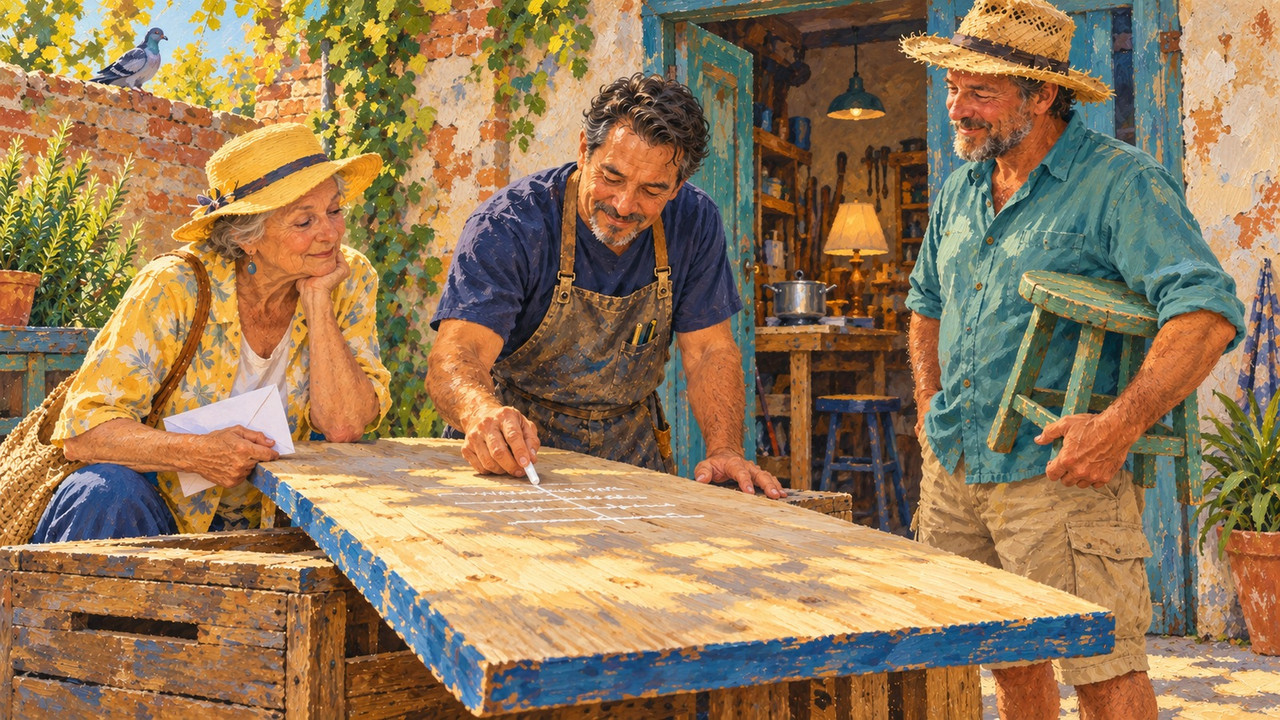
Celia arrived first, wearing a yellow hat and carrying a small green stool. She had brought exact payment in a folded envelope, although Ruben had not yet named a price.
“I know what my kitchen needs,” she told them. “I’ve been sitting on it sideways.”
The stool had one shortened foot and layers of paint rubbed smooth at the seat’s edge. On the underside were penciled names. Florida Man turned it carefully, keeping his fingers away from a loose splinter.
Ruben explained the echo. Celia listened, then looked toward the brick wall.
“I have a sister like that.”
The wall had said it a breath earlier. Celia lifted one eyebrow, impressed by the timing if not the manners.
Ruben measured the short leg. He could fit a new foot. The paint would take longer, if she wanted the whole stool stripped and finished again.
“Strip it,” said Celia’s voice from the courtyard.
Ruben reached for a clean job card.
Celia touched the seat. Her real mouth remained closed.
Florida Man put his pencil across the card. “Is that still what you want?”
She turned the stool back over. Beside one penciled name was a long green thumbprint.
“My daughter helped with that coat,” she said. “Helped is a generous description. I’d forgotten the thumb.”
She rubbed the mark lightly, then handed the stool to Ruben.
“Just the foot, please.”
He crossed out the word strip before he had finished writing it.
By eleven, Florida Man had a row of objects and a collection of answers nobody had quite given. The courtyard offered prices before Ruben had looked at joints. It said “Certainly” while he was still deciding whether he knew enough about a lamp. It agreed that a drawer could be ready tomorrow, although tomorrow already contained two chairs and a visit to his aunt.
Each time, Ruben stopped to explain. Each time, somebody who had heard an answer had to wait for another one.
A man with a saucepan smiled gamely through his third correction. “Could I leave it and go? I’m fairly sure about the handle.”
Florida Man wrote his name and telephone number. He put the pan aside without a completion date. In the doorway, other neighbors began discussing whether they could come back later.
Ruben wiped his hands on his apron. He had done almost no work, but he looked as tired as if he had repaired every chair in Pensacola.
“I can’t open like this,” he said.
The wall had supplied the sentence first. Hearing it twice made Florida Man’s stomach tighten.
He asked Ruben to come into the shop. They stood beside the bench with the door between them and the courtyard. Ruben picked up a job card.
“Three dollars for the foot,” he said.
Nothing spoke ahead of him.
They could receive everything indoors. But the shop was narrow, the bench occupied most of it, and the little line outside would soon stretch into the street. People carrying lamps deserved somewhere better to stand. Florida Man looked through the doorway at Celia, who had taken a chair and was patiently defending the saucepan from a passing elbow.
“Let’s bring the paper to them.”
He wrote FOOT ONLY on Celia’s card, then added the price and Friday. He gave it to Ruben without reading it aloud. The courtyard made no announcement.
Ruben took the card out to Celia. She studied it, circled FOOT ONLY, and wrote YES beneath Friday. The only sound was the pencil rasping against the paper.
“Oh,” she said.
The wall had said oh first, but the agreement was already made.
Celia held up the card. “You’ll need something larger than this. People want to know what they’re waiting for.”
The blue board lay beside the bench. Its unpainted back was broad and clean. Ruben looked at his orderly hooks, then at the objects waiting in the yard.
“They can wait another day,” he said.
He and Florida Man carried the board outside. They rested it across two empty crates with its hooks underneath. On the bare back, Ruben wrote three headings in chalk: OBJECT, WORK, READY. Celia fetched the cards and made a space for each owner’s answer.
Florida Man thought the morning might settle now. He could put a question on paper before a sentence began gathering behind anybody’s teeth.
Then Celia brought him her envelope.
Inside were three dollars and a note: For the whole stool.
She had prepared it at home, expecting more work than she had finally chosen. Florida Man showed her Ruben’s card again.
“Yes, I saw,” she said. She looked toward the doorway. “He always charges me too little.”
Ruben came out carrying the piece of wood he had chosen for the new foot. Celia put the envelope in his apron pocket.
“You’ll take that, and charge me properly for your time.”
“Six,” said Ruben’s voice from the wall.
His face reddened. His hand closed over the pocket, as though he might press the first price back inside.
Celia had heard. So had the neighbors nearest the board.
Florida Man turned the chalk toward Ruben. He held the stool while his friend looked at the new foot, the envelope, and his own name on the doorway.
Ruben took the chalk. Under Celia’s repair he rubbed out THREE and wrote SIX.
Celia opened her purse.
He put his hand over the new figure. For a moment Florida Man thought he would rub it out again. Instead Ruben added INCLUDING FITTING AND FINISHING THE NEW FOOT. He drew a little line below it, leaving the old green seat out of the work.
Celia read every word. Then she counted out three more dollars and placed them on the board.
“Friday,” the wall said.
She pointed to the date already written on her card and nodded. Ruben gave her the envelope back for her change, though there wasn’t any.
Florida Man carried the stool inside. The thumbprint stayed green beneath his palm.
By lunchtime the board held eight jobs, each with an answer in its owner’s handwriting. One lamp had a question mark and the name of an electrician Ruben trusted. The saucepan owner had agreed to Monday. Nobody had been promised a new saucepan.
Celia went home to eat and returned with a sandwich for herself and one for the man minding the cards. Florida Man accepted his without consulting the courtyard.
From inside came the soft stroke of Ruben’s plane. A matching sound arrived from the bricks just before it. Florida Man could hear the difference now: one had no wood beneath it; the other made a curled shaving fall across his friend’s wrist.
He put Celia’s card at the front of the repair tray. On its back, she had added a drawing of the green thumbprint, so there could be no misunderstanding.
The real Gulf behind the tale: voices and working history in Pensacola
Pensacola’s recorded history includes the work of people who built, traded, fished and made things. The University of West Florida Historic Trust’s virtual tour identifies lumbering, brick making, railroads and commercial fishing among the industries interpreted at its Museum of Industry. It also describes Voices of Pensacola, opened in 2014, as a place for the city’s diverse histories, including recorded personal stories and an oral-history recording room.
The official Voices of Pensacola page describes the Hilton-Green Research Room’s documents, maps and photographs. These collections offer ways to explore the city through the people who lived and worked there. The repair shop, its neighbors and its anticipatory echo belong to this fable; they are not an account of a real museum program, documented local legend or acoustic phenomenon. For actual exhibits and visiting arrangements, consult Historic Pensacola’s current information.