Sarasota: Florida Man and the Parade of Overambitious Shadows
A Gulf fable · Sarasota
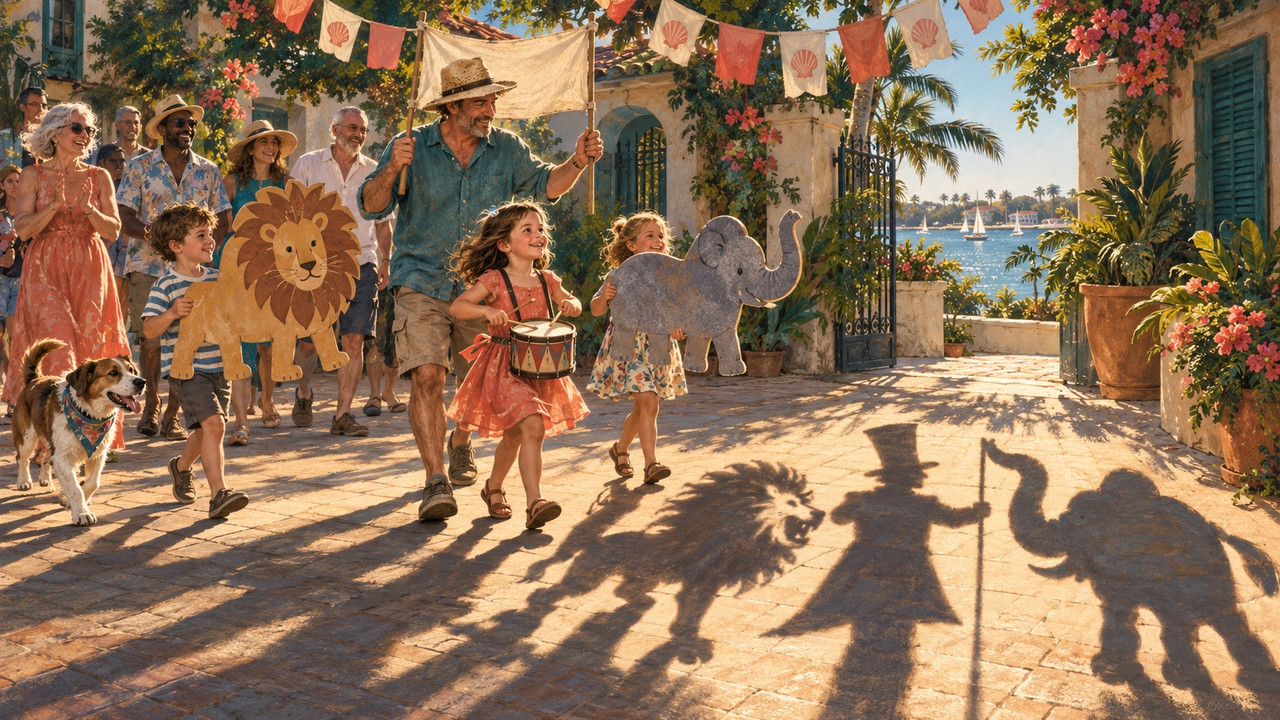
Florida Man had agreed to carry a banner around a courtyard in Sarasota. His shadow arrived wearing a top hat, which seemed an ambitious interpretation of the job.
When he scratched his neck, it took a bow. When he lowered the banner, it waved an imaginary baton. The baton kept waving after his arm stopped.
“We're going to have trouble with the payroll,” he told Lila.
She laughed and tightened the strap on her little drum.
The neighborhood parade had been her idea. She had practiced a marching tune and made a cardboard lion whose mane consisted of twenty-seven separate curls. Her mother had supplied the drum. Other neighbors had brought paper elephants, bunting and an extremely tall giraffe. Sarasota's circus heritage had inspired everybody; Florida Man hoped it would stop short of inspiring a trapeze.
Lila wanted the parade to reach the far arch with her lion still looking like a lion. The cardboard had spent a week drying on the kitchen table. Her family had eaten at one end, cautiously.
Florida Man wanted to give them all a pleasant lap, then get the banner back to its owner. He had checked the paving stones, moved a chair that pinched the route, and brought string for the giraffe's uncertain neck. The practical work was done.
The shadows had evidently finished theirs too.
A paper elephant cast an enormous trunk that investigated the refreshment table. The giraffe's shadow bent its neck down to inspect the lion. Florida Man's ringmaster pointed toward the arch.
“Shall we?” he asked Lila.
She struck her opening beat. The paper animals moved. So did their shadows, at first with respectable obedience.
Then the elephant's carrier stopped to adjust a strap. The elephant shadow continued across the stones.
Florida Man halted the banner before anybody walked into anybody else. Lila caught her lion by the cardboard body. Its shadow took three more steps and left it behind.
The courtyard filled with animals that nobody was holding.
A neighbor raised her paper elephant. Its ordinary shadow remained at her feet, small and puzzled-looking. The grand elephant had gone to join the giraffe. Florida Man looked down. His own ordinary silhouette was there too, while the ringmaster now stood several yards away.
“We've acquired a second parade,” he said.
Lila followed the lion as far as the clear middle of the yard. It had a mane larger than a garden umbrella. She held up the cardboard. The grand lion put one paw against her ordinary shadow, as if checking a ticket, and turned away.
“It thinks it can do better without us,” she said.
The ringmaster swept its baton toward the others. They formed a line and set off around the courtyard, taking strides far longer than their makers had intended. The elephant passed through a chair's shadow. The chair slid six inches across the stones.
Florida Man put the banner down and steadied it.
“Keep the chairs clear,” he called. “Let them have the paving.”
The neighbors moved what they could. The shadows traveled across the dark stripes beneath the bunting, connecting themselves from patch to patch. In full sun they stretched, thin as spilled ink, then thickened beneath the next stripe.
Lila's mother lifted the little drum out of the lion's path. Lila stepped beside her, unharmed and furious.
“That mane took ages.”
“It certainly appreciates the work,” Florida Man said. “It has made twenty-seven considerably larger ones.”
She looked toward the far wall. Across it lay the shadow of the arch, a dark semicircle large enough for the marching elephant. The ringmaster pointed there. The animals accelerated.
The first shadow reached the wall and climbed it. A small paper zebra lay forgotten beside a planter. Its grand counterpart passed into the arch's dark curve, flattened, and stayed there.
The boy who had made it called. It did not turn.
Florida Man picked up the cardboard zebra. He took it toward the wall, watching the paving as he went. Its small shadow reached the trapped zebra's foreleg. Where the two touched, a thin stripe peeled away from the wall and returned to the cardboard.
He moved the paper closer. The stripe thickened. Then the evening sun slipped behind the edge of a roof, his small shadow lost the wall, and the grand zebra settled back into the dark arch.
He returned to the neighbors with the zebra still in his hand.
“They need their own shapes touching them. We can't get all those shapes onto that wall from here.”
The wall faced the wrong way. To cast a shadow high enough, a carrier would have had to stand on a planter or a chair. Florida Man had no intention of adding airborne neighbors to the circus.
Lila looked at the banner laid across its two poles. It was pale canvas, with colored letters down the middle.
“Could we bring the wall to them?”
He followed her gaze. “We could bring a screen.”
They lifted the banner between them, Florida Man holding one pole and Lila's mother the other. The canvas caught a long patch of sunlight. The paper zebra's ordinary shadow appeared on it, crisp and dark.
The grand zebra paused on the wall.
Florida Man brought the canvas close enough for its lower edge to touch the arch's shadow. The zebra slid onto the cloth. He raised the cardboard behind it, and the two silhouettes met.
For an instant the banner pulled hard against his hands. Then the grand zebra folded into the ordinary one. The boy took his animal back. Four neat cardboard legs cast four neat shadows at his feet.
He grinned. “Mine's finished with the parade.”
The elephant was arriving. They turned the screen for its carrier. The enormous ears spread across the canvas, wrinkling it. Florida Man braced the pole and felt a tug run through it to his shoulder. As the paper elephant's shadow touched its larger self, the tug eased.
The giraffe followed, its long neck gathering like a stocking pulled onto a foot. The neighbors laughed and called instructions. Lila beat a cheerful roll on her drum while they worked. The shadows paid it no attention whatsoever.
Her lion reached the wall last.
She held up the cardboard. The ordinary mane cast one broad dark circle. On the screen, the grand lion's mane lay in separate curls, each stretching farther than her arms could reach. The circles touched; the curls did not. The lion put its paw against the canvas and pushed.
Florida Man's pole bent. He lowered his shoulder against it.
“We can leave the lion on the wall for a while,” he told her. “Get a bigger piece of cloth.”
The arch's dark curve had climbed almost to the top of the wall. In another minute the roof's shadow would swallow it. Lila looked at her mane, then at the scissors on the refreshment table, left there after somebody trimmed the bunting.
“Hold it flat for me.”
Her mother held the cardboard body. Lila cut carefully between the curls, opening them farther apart. One snapped at its narrow base. She pressed her lips together and continued. The beautiful solid mane became a ragged fan.
She lifted it behind the canvas. Each paper curl threw a separate shadow now. The grand lion turned its head. A dark curl touched a smaller curl and shortened. Another followed.
Florida Man felt the pole straighten. Lila adjusted the fan with both hands, spreading it until the final curl found its place. The lion's great head folded down into the small one. Its paw left the canvas.
Her cardboard lion looked rather as though it had slept in a hedge. Its shadow was entirely its own.
The ringmaster remained on the wall, bowing to a courtyard full of people who had stopped watching it.
Florida Man raised his free hand behind the screen. An ordinary finger shadow touched the tip of the baton. It shortened to a finger. He raised his other arm; Lila's mother took his pole. The ringmaster's shoulders met his shoulders across the canvas.
The top hat resisted.
Florida Man took off his battered real hat and held it sideways above his head. Lila laughed, then helped him tilt it until the brim's shadow touched the grand one. The enormous hat collapsed like a traveling bag.
He lowered his arms. His shadow lowered its arms. He checked once more.
“Welcome back.”
They returned the chairs, straightened the arch and began their original parade. Lila played the whole tune. The lion's loose mane bounced with every step. Halfway round, she asked the zebra's maker to carry it while she played with both sticks.
At the far arch, Florida Man looked down. His shadow wore his own modest hat and held the banner without flourishes.
Afterward Lila spread the lion on the refreshment table. The boy with the zebra brought paste. Someone found the spare paper. Florida Man put the scissors within reach and went to return the banner.
His shadow took a very small bow as he left.
He decided it had earned that much.
The real Gulf behind the tale: Sarasota circus history
A circus leaves things behind as well as memories: the clothes worn in performance, the objects handled onstage and the posters that announced the show. Families from Sarasota's circus community contributed such material to the early collection of the Circus Museum. The Ringling's historical archive dates the museum's establishment by Chick Austin to 1948.
Sarasota was also home ground for people whose working lives took them on tour. The Circus Museum teacher guide records the community's off-season life and identifies 1927 as the year John Ringling established the circus winter quarters here. Read beside the museum archive, that account gives the donated objects a local context: they came from people with lives in Sarasota as well as careers in the ring.