St. Joseph Bay: Florida Man and the Reflection That Stayed
A Gulf fable · St. Joseph Bay
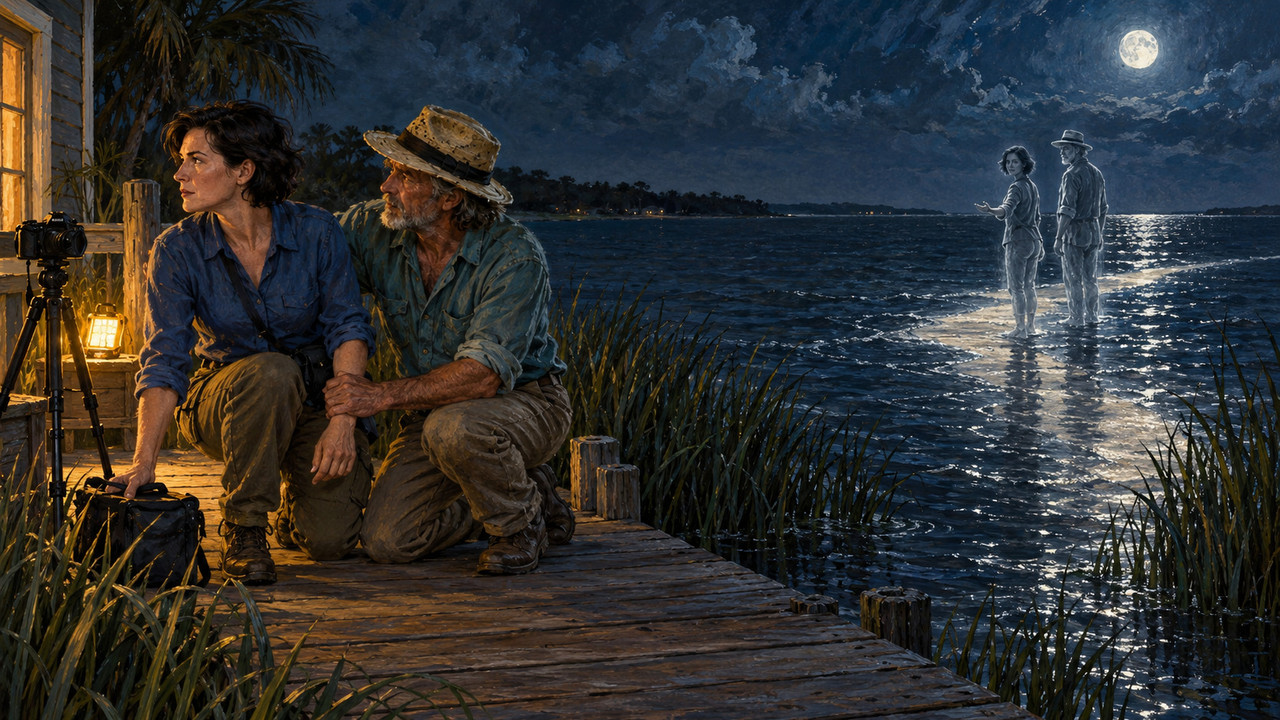
Ruth wanted a photograph with no road, roof, or electric wire in it: only St. Joseph Bay, a little marsh, and the moon. Florida Man had agreed to hold her lamp. He considered this the one job in photography for which he was fully qualified.
“Don’t jiggle it,” she said.
He lowered his cup of coffee. “You keep adding qualifications.”
They stood on a low wooden platform at the water’s edge behind her house near Port St. Joe. She had chalked a line well back from the edge for the tripod. Beyond the platform lay a narrow tidal channel, then a pale sandbar that had emerged as the water fell. Florida Man had seen that channel by daylight. It was deeper than it looked.
Ruth set the camera’s timer. She put small scissors, a roll of tape, and a black card back in her bag. They had used the card to shade the lamp so its light reached the marsh stems without shining into the lens.
Across the bay, the peninsula was a dark line. A breeze combed the water. Florida Man kept his lamp steady while the camera worked. Ruth watched the moon’s long broken reflection.
When the shutter closed, she looked down at her screen.
“Too much light on the left. Move back a little.”
He took two steps inland.
The amber reflection of his lamp stayed where it was.
Ruth glanced from it to him. He lifted the lamp. The little rectangle in the bay remained level among the stems. Ripples crossed it without bending it.
“Somebody across the water?” she asked.
Florida Man switched his lamp off. The far shore was dark. Their rectangle still shone.
He turned the lamp on again, suddenly grateful for its ordinary weight.
Ruth bent to check the camera. Below her, the other Ruth stayed upright.
He said her name quietly.
She looked up, then down.
Her reflection wore her blue shirt. It stood beside his reflection, which held an amber lamp in both hands. The bodies were upside down, heads nearest the platform, as reflections ought to be. But the other Ruth had not bent toward any camera.
Florida Man raised his right arm. The man below raised his left. He lowered his arm. The other man held his up, palm outward, as though requesting a little patience.
Ruth took a step toward the house. Her reflection remained beside his.
“We’re done for tonight,” Florida Man said.
She nodded. He moved the real lamp inland and aimed it at the boards. That gave them a bright path to the yard. Ruth began gathering her bag. She left the tripod until last.
While she wound the strap, her reflection knelt.
The other Florida Man set down his lamp. Below their heads, the water changed. A pale strip widened between the platform and the sandbar, filling the place where Florida Man remembered the tidal channel. It looked like firm wet sand.
The other Ruth walked across it.
She had turned upright.
Florida Man’s fingers tightened on the handle. He could see her whole body now, feet nearest him, head beneath the reflected moon. She stopped among the marsh stems and looked back. She lifted one hand to show them where to stand.
The place was perfect for Ruth’s photograph. The moon framed by reeds. No platform. No house behind them. The far peninsula lying straight beneath the sky.
Ruth said, “That’s the angle I wanted.”
She took the camera off the tripod.
He put out his free hand, stopping short of touching her.
“The channel’s still there.”
“I know.”
But she had started walking toward the outer edge, eyes on that pale path. Florida Man swung the lamp down. Water gleamed directly below the platform. There was no sand beneath the light.
Ruth stopped with her shoe close to the edge. Her breath came out sharply.
“I saw boards,” she said.
He looked only at her feet. “You’re on them. Stay there.”
The other woman waited on the sandbar. With patient fingers she adjusted a camera strap that had never existed in the reflection before.
Ruth knelt to set her real camera down. When she straightened, her cuff caught on the end of a small mooring cleat fixed to the platform. She tugged once. The fabric tightened across her wrist.
Florida Man set the lamp behind her, facing inland. He knelt too, keeping his back toward the bay, and felt for the caught sleeve.
“Give me a little slack.”
She bent her elbow. He worked a finger beneath the cotton. A fold had twisted under the cleat’s hook; he would have to lift it sideways.
Behind Ruth, something made a soft, flat knock against the wood.
She turned her head.
Her arm pulled straight. Florida Man caught her wrist before the movement could bring her off balance. His thumb pressed against the quick beat of her pulse.
“Look at the house.”
Her head came around slowly. The sleeve loosened. He could feel her trying to obey, and something in her pulling another way.
“It looks so easy,” she said.
“What does?”
“To get over there.”
He shifted his knees farther inland, bracing himself. He had never disliked his own curiosity more. Whatever had knocked was behind him, and every part of him wanted to turn and see it. He looked at Ruth’s camera on the boards instead. Its strap lay in a shapeless heap. A bit of sand was caught beside the shutter button. Nothing there was perfect.
“We can take the picture tomorrow.”
“The moon won’t be there.”
“Then a different one.”
The knock came again. Ruth’s wrist moved in his grip. He could not release it and trust her feet. He could not unhook the twisted fabric with one hand.
“Your scissors,” he said. “In the bag.”
She reached back with her free hand. The bag lay against the houseward end of the tripod. Her fingertips brushed its strap, missed, and found it again.
“Don’t look for it,” he said. “Feel.”
Ruth closed her eyes. She drew the bag toward her, then pushed her hand inside. Florida Man watched the sleeve, her shoes, the plain dark seam between two boards. Water murmured underneath them. He could almost hear someone demonstrating how simple it would be to step down.
Ruth found the scissors.
With her eyes still shut, she passed them into his free hand. He opened them, slid one blade beneath the tight cuff, and cut. A few threads parted. The fold still held. He cut again, farther along the seam.
Ruth’s eyes opened toward the bay.
Her wrist turned beneath his thumb.
“Close them,” he said.
She squeezed them shut. “Tell me when I’m facing the house.”
She turned her head. Her body followed a little, heel scraping wood. Florida Man held her until both shoes were flat.
“There.”
She opened her eyes to the lamp’s light across the boards.
He made the last cut. The cuff tore free.
Ruth stayed looking inland. She picked up her camera. Florida Man put the scissors in her bag, lifted it, and rose beside her. He could feel the bay at his back as distinctly as a person standing close.
His own voice spoke behind him.
“Don’t jiggle it.”
Ruth stopped. For a moment Florida Man thought she would laugh, and then he saw how tightly she held the camera.
“Leave the tripod,” she said.
They walked toward the house by the real lamp’s small amber path. At the yard, the voice said his name. It had his exact way of saying it, half amused, as though he had forgotten something obvious.
Florida Man kept walking.
Inside, Ruth closed the curtains. She found a needle and sewed her cuff while he held the lamp. Her stitches were large and crooked. She did not hurry to finish them. When she put the shirt on again, the little white line of thread stood out against the blue.
They fetched the tripod together in the morning. The bay moved under a plain bright sky. Marsh stems divided their reflections into harmless pieces. The pale sandbar had gone under again.
Florida Man picked up the tripod. Ruth stood beside him in her mended shirt, holding the lamp he had forgotten to pack.
In the water, her cuff was whole.
He did not mention it. He straightened, took the real lamp from her hand, and went back up the path with her.
St. Joseph Bay and its two shores
St. Joseph Bay lies beside the long, narrow St. Joseph Peninsula near Port St. Joe. The peninsula offers contrasting coastal habitats: sandy beaches and dunes on the Gulf side, with salt marshes along the bay side. Florida State Parks describes the area as important habitat for sea turtles, shorebirds and the endangered St. Andrews beach mouse. Those habitats give the fable its pale sand, dark marsh edge and changing waterline.
The peninsula’s dunes are part of a living coastal system. Wind moves beach sand inland, while dune plants help catch sand and stabilize it. Their roots and stems contribute to the dune’s shape and resilience. A still-looking shoreline therefore belongs to a landscape shaped continually by wind and water. Read more from Florida State Parks at T.H. Stone Memorial St. Joseph Peninsula State Park and Sand Dunes Play an Important Role.